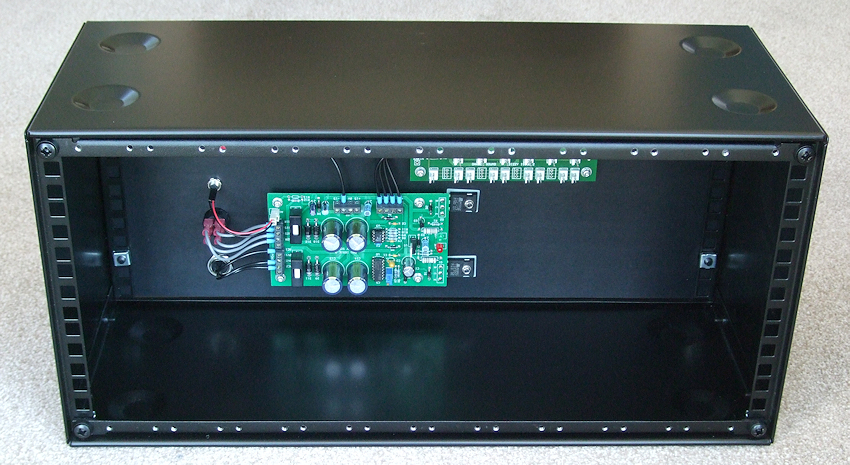
The first thing that any modular builder needs is a case and a power supply. This is a 5U high 200mm deep 19" rack case from All Metal Parts fitted with a pair of their modular rack rails. A 19" wide case has a horizontal width of 10U . Most Oakley modules are 1U wide but some like the VCO are 2U. At the rear of the case you can see an older Oakley PSU and Dizzy mounted on a blank 19" panel.
Which modules make up a modular synthesiser?
The most basic synthesiser system will normally consist of:
VCO - this makes raw sound of the synth, analogous to the strings of a guitar. You can use either our small SVCO or larger VCO.
VC-LFO - this will allow you to modulate certain functions on the other modules, eg. vibrato which is modulating the pitch of the VCO
VCF eg. COTA or Superladder - this shapes the raw sound of the VCO and controls it harmonics or brightness
ADSR/VCA - this shapes the volume of the sound, but it can also sweep the filter for that characteristic synth sound
midiDAC midi-CV interface - to control the pitch of the VCO and to gate the ADSR when you hold a key down
Multimix - For mixing of audio and CVs
Power supply and distribution board - to power your modular.
A midi keyboard or other controller - so you can actually play your modular
A case - to house your modules. Ready made or custom built 19" rack flightcases are the easiest to use.
This is the bare minimum really and will give you a synth somewhat like a SH-101 but with more flexibility.
Cases
For studio and home use you should also consider the cases from All Metal Parts in the UK as they have a good range of flat pack 19" rack (ie. 10U wide for 10 single width MOTM format modules) 5U, 6U and 10U metal cases with rack rails to the front and rear of the case. As an example their 5U high, 300mm deep case is part number AMP05007. They can also supply blank panels (eg. AMP130045) for any rear mounted power supplies and pairs of rack rails (AMP31002) for mounting your modules.
Flightcase Warehouse in the UK can supply 19" rack sleeves and flightcases for a very good price. I recommend their bespoke service if you need a shallower case or backless case.
To mount standard Oakley MOTM format modules into a 19" rack you will need a pair of either All Metal Part's AMP31002 or Synthcube's MOTM 19A rack mounting rails, for every 5U of height.
What order should I build the modules?
Once you have your case sorted your first module should be the power supply. No module can work without a power supply so it makes sense to do this part first. Do not skimp on the power supply or the distribution system. Good quality power and cabling will save lots of time later on and will ensure your modular sounds good. The Oakley PSU is good quality, easy to build and a safe option.
I would recommend the next module you should get is a VCO. On its own it is not much use but the oscillator will act as a signal source for all your other modules.
The third module will probably be the midiDAC to allow for keyboard control of the modules. You may already have a midi-CV convertor, or a CV/gate output synthesiser, so in this case you may not need a midiDAC.
Then you should consider building a filter, an ADSR/VCA, and an LFO.
This should give you a great sounding synthesiser with a huge potential on which to expand.
Expansion
The next stage for a traditional music synthesiser could then look like this:
Another VCO - to allow for richer textures, cross modulation options, and simple chords
VCO Controller - a master controller for changing octaves on the fly and adding vibrato with either aftertouch or modulation wheel
Dual VCA - you can never ever have enough VCAs. Use them to control the modulation depths of other CVs and audio paths
Another ADSR/VCA or VRG - a dedicated envelope generator to sweep the filter for that characteristic synth sound
Another filter - Different types of filters sound and behave different. Also, filters can be used in series and parallel.
Noise/Filter - for creating non pitched sounds like the rattle of a snare, deep rumbles or explosive hisses
Fourmix - For additional mixing of audio and CVs
Discontinuity - our unique waveshaper and ring modulator. Create new esoteric sounds.
Router - A pair of passive multiples, as well as a useful set of four input and output amplifiers.
However, everyone will have their own pathway to their ultimate synth system. Indeed, not everyone starts with VCOs and many use their modulars to process external sounds. They would perhaps start with an EFG-Deluxe and then have different types of filters, as well as some of my interesting effects modules like the Overdrive, MOSPhaser or Flanger/Chorus.
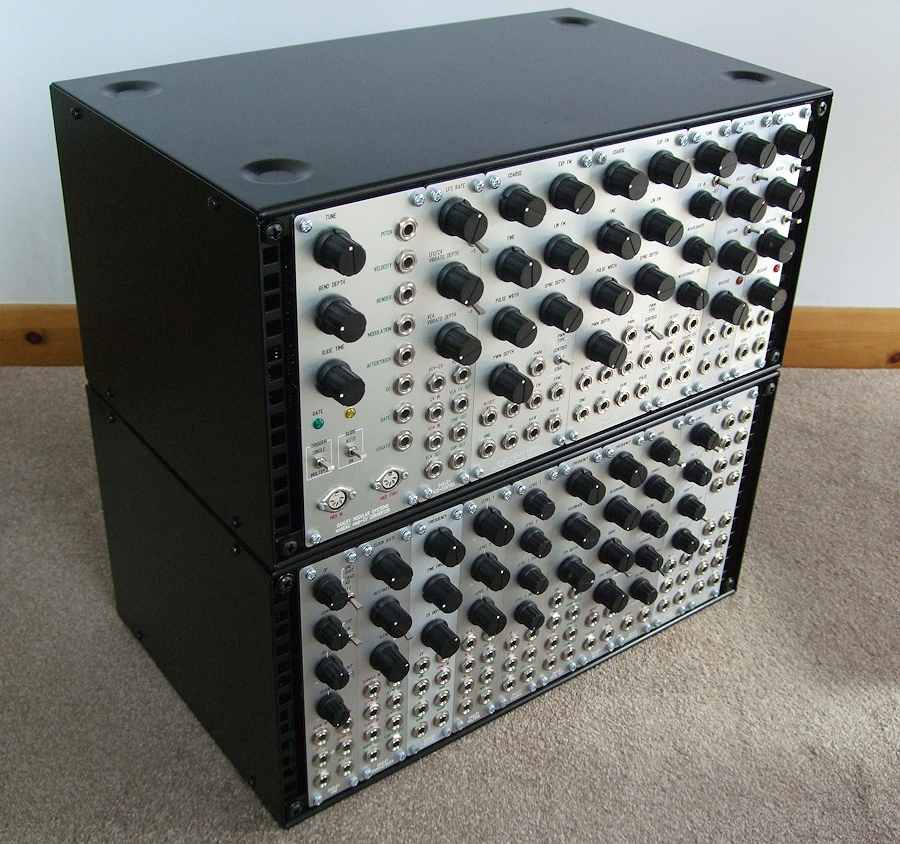
An example of a powerful Oakley modular
system built into two 19" rack cases. Case 1: midiDAC, VCO
Controller, VCO, VCO, SVCO-A, ADSR/VCA, ADSR/VCA
Case 2: VRG, Sample/Slew, VC-LFO, Multimix, Fourmix, COTA, DLF,
Overdrive-II, Dual VCA-X, Router
Any other useful information?
Gordon Reid's Sound on Sound articles are pretty good for learning all about sound synthesis in general.
www.soundonsound.com/sos/allsynthsecrets.htm
The ARP2600's Owners Manual is also a good read:
www.guitarfool.com/ARP2600.html