For technical support on all Oakley projects please now refer to the knowledgeable and helpful Oakley Sound Forum which is hosted at ModWiggler.com. I do not provide official building support for Oakley projects, but I am usually available for help via the forum.
Do you supply ready made units?
I only sell bare printed circuit boards and a few parts for people to construct their own modules.
Do you sell whole kits?
Oakley Sound do not sell full DIY kits. However, an increasing number of full component kits for Oakley 5U and Eurorack modules are on offer at Synthcube in the US.
I thought you sold modular synthesisers?
I no longer sell PCBs to make modular synthesisers. Many of my modular designs are now available from Synthcube.
Do you supply ready made cases?
No. For studio and home use you may wish to consider the cases from All Metal Parts in the UK as they have a good range of flat pack 19" rack (ie. 10U wide for 10 single width MOTM format modules) 5U, 6U and 10U metal cases with rack rails to the front and rear of the case. As an example their 5U high, 300mm deep case is part number AMP05007. They can also supply blank panels (eg. AMP130045) for any rear mounted power supplies and pairs of rack rails (AMP31002) for mounting your modules. I recommend 200mm deep cases for use with the recommended external 'line lump' power supplies, while the deeper 300mm ones should be used for internally mains powered systems.
To mount standard Oakley MOTM format modules into a 19" rack you will need a pair of either All Metal Part's AMP31002 or Synthcube's MOTM 19A rails for every 5U of height.
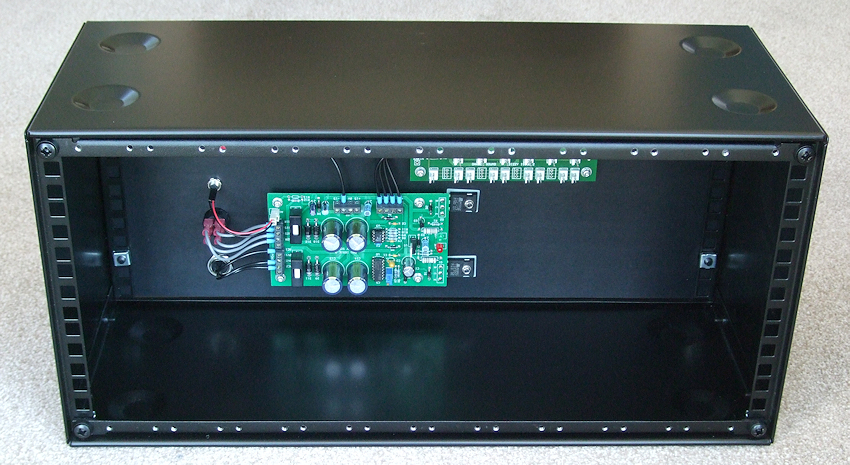
A 5U high 200mm deep 19" steel case from All Metal Parts. Front and rear rack strips are fitted to allow the module rack rails to be mounted on the front and a power supply panel to the rear.
Unless you need a very shallow depth for horizontal work then for Eurorack systems I recommend again using the steel cases available from All Metal Parts in the UK as they have a good range of flat pack 19" rack (ie. 84HP wide) 3U, 6U and 9U high metal cases with rack rails to the front and rear of the case. The modules are then held in place using 84HP mounting hardware such as 'Z rails' and 'Z ears' from TipTop. Although wood cases look beautiful they can allow excessive heat to build up within your modular unless sufficient air gaps are created, and, unless sufficiently screened, do not stop unwanted radio interference either entering or leaving your modular.
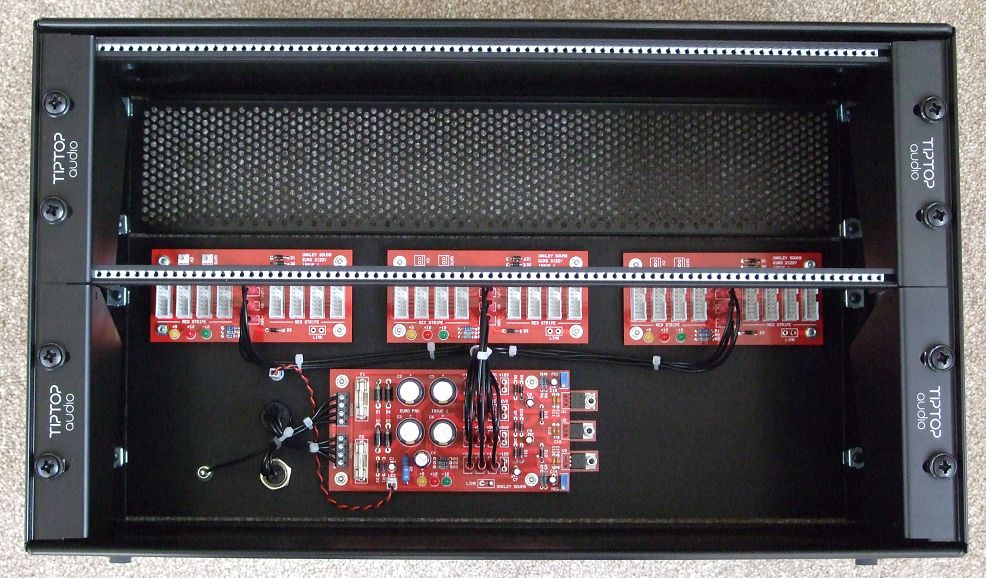
Three Euro Dizzy boards powered from one Oakley Euro PSU fitted to a 4U high aluminium 19" rear mounted panel in a 6U high 200mm deep rack case from All Metal Parts. Module mounting rails and rack ends are from Tip Top Audio.
Where do you get your front panels?
Either at Schaeffer in Germany or Frontpanel Express in the US. Alternatively, you can obtain panels for many 5U and Eurorack modules from Synthcube in the US.
Can I buy the Schaeffer front panels direct from Oakley Sound ?
No. These need to be ordered from Schaeffer in Germany or Front Panel Express in the US. Both companies offer an excellent service. The Frontplatten Designer software is a free download and features secure online ordering too. See the Schaeffer or Frontpanel Express websites for more information.
Do you have any older issue PCBs for sale?
No. The only PCBs that I have for sale are the ones listed on the project webpages. If you do need an older PCB, maybe to match up with an older panel design, then please do post a request on the support forum.
Can I buy schematics/PCB artwork for the modules?
I do not sell any schematics for any of our currently sold modules or PCBs. Relevant schematics are only provided for purchasers of the project PCB.
Schematics for most non current Oakley projects are available from Oakley Sound as pdf files for a small fee, although do check the legacy support page to see if they are available for free download.
PCB artwork is not available for any of my products old or new.
Are your projects hard to make?
This one is tricky to answer. It all depends on your ability. If you can solder reasonably well, and have the patience to read through all the documentation, you should be able to manage. However, if you rush and find your project doesn't work, that's when you are going to need more electronic knowledge. Being able to read a circuit diagram is an obvious advantage. If you want to get started, perhaps, a good way is to start on something simple.
My Oakley DIY project doesn't work, what then?
Join the Oakley Sound Forum which is hosted at ModWiggler.com. Then after checking that your question hasn't already been answered you can post to the list for advice. I, and many other builders of Oakley equipment, are present on the forum and should be able to help.
Please do not contact me directly regarding building problems or generalised parts enquiries. All enquiries for help should be made through the Oakley Sound Forum.
Are all your boards lead-free?
All boards are RoHS compliant, which means they do not contain lead (Pb) . All boards can be soldered with either lead free solder or lead based solder. The boards are finished using a lead free HASL process.
What sort of solder should I use?
All of my current boards can be soldered with either lead free or old fashioned leaded solder. I still prefer to use Pb/Sn solder for my own projects because it is easier to work with.
Who are Oakley Sound Systems?
The company was originally called Sound Systems and was formed by me, Tony Allgood, in 1984 whilst I was studying at university. Initially, it was only a side line to my professional career as an electronic design engineer. However, in 1996, as interest had grown sufficiently in my products and services, I formed Oakley Sound Systems. At first this was predominantly a repair business to local music shops and musicians, but the growth of the internet allowed me to start to manufacture and sell PCBs and other products.
In the period between 1999 and 2005 Oakley Sound Systems sold ready made modulars, modules and printed circuit boards direct to people all over the world. My modules have been used in film production, at live concerts and in many hundreds of home studios.
In June 2005 a decision was made to hand over all merchandising to another company whilst continuing to design new products. Then in September 2010 Oakley Sound Systems started to sell PCBs directly again. In March 2016 the repair and servicing side of Oakley Sound Systems was closed so that I could spend more time developing new products.
By 2026 it was time for me to retire and sales of my modular designs were handed over to Synthcube.
Can I build these modules to sell to friends?
Of course, you can.
What is a GBP?
It is the currency of the United Kingdom.
GBP is a short hand way of writing 'Great Britain Pound'. This is the accepted way of writing our currency by the International Standards Organisation when you can't use the ordinary 'curly L' pound sign. Paypal and the webpages on this site use GBP. It should be noted that UKP, although more correct in terms of the countries that it represents, should not be used.
GBP is called 'pounds sterling' on the money markets. It is not affiliated to the Euro in any way.
100 pence make 1GBP. So 6.50GBP is six pounds and fifty pence.
Where on Earth is the United Kingdom?
Not quite a FAQ, but I have had it asked a few times now. The UK is currently England, Scotland, Wales and Northern Ireland. Great Britain is just England, Scotland and Wales. The word 'great' in Great Britain originally comes from an early designation of it being the larger of the two main land masses that form the British Isles.
The UK lies north of France in Europe, but is not connected to mainland Europe. A narrow stretch of sea called the English Channel separates us from France.
I live in rural Cumbria, England, 20 miles from the Scottish border, and close to the Lake District. The Lake District was home to many famous people such as Coleridge, Wordsworth, and Beatrix Potter.
Can I make my SRE330 (or other rack project) internally mains powered?
If you have the skills to do this you probably wouldn't be asking the question. Only fit an internal mains supply if you know what you doing. I cannot endorse this method of powering any Oakley product.
Where do I get all the other parts for the project?
Rapid Electronics (UK), Mouser (Worldwide), CPC (UK), and Farnell/Newark (UK/US). Small Bear (US), Banzai (Germany) and Musikding (Germany) are also useful.
Parts codes for most of the common parts used in Oakley projects can be found in our lengthy parts guide which is found here. This is a PDF document which also contains many Rapid, Farnell and Mouser order codes that you may find useful.
What's the Mouser / Farnell / Rapid (etc) part code for ....
Due to limited time I am not able to answer this question for every part you need to buy. My Builder's Guides and Parts Guide should give you sufficient information for you to purchase all the parts from your own suppliers without too much difficulty. You will also find that the Oakley Sound Forum will be very helpful too if you do get stuck.
Rapid, Farnell and Mouser part codes for most of the common devices used in Oakley projects can be found in the Parts Guide.
What is the form factor of those Alpha or ALPS pots you use?
For the 5U and rack modules the pots I use are the very common 16mm format that is preferred by many modular and synthesiser manufacturers. There is 0.2" between pins in one gang and gangs are separated by 0.2". There are two gangs in a stereo pot and one gang in a normal mono pot. Shaft length varies with supplier but it may be cut down with a hacksaw or Dremel. Shaft diameter is either 6mm or 6.35mm (1/4") and you can buy them in either slotted knurled shafts for push fit knobs, or smooth round shafts for screw fit knobs. All newer eurorack modules use the common 9mm vertically mounted pots.
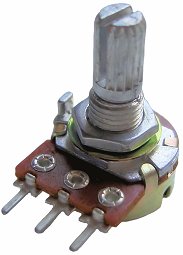
This is a 16mm Alpha pot with a short knurled 6mm shaft.
Do I get a paper invoice with my order?
Smaller orders, that is, those below 270GBP, will not include a paper invoice. Larger orders will typically have the invoice attached to the outside of the parcel, and usually another inside the parcel. However, all customers will be sent an invoice as a plain text e-mail as soon as I confirm payment has been made. This contains all the details of the order. All customers are given their own individual customer order number, and I keep a full record of all transactions for around seven years.
What is your VAT registration number?
Unlike many countries, small businesses in the UK do not require VAT registration. I therefore have no VAT number nor do I charge VAT on any of my products. However, VAT may be collected by your country's border agency acting on your government's behalf. If this is the case, you will normally get an e-mail or letter telling you that VAT needs to be paid before your order can be handed over to you.